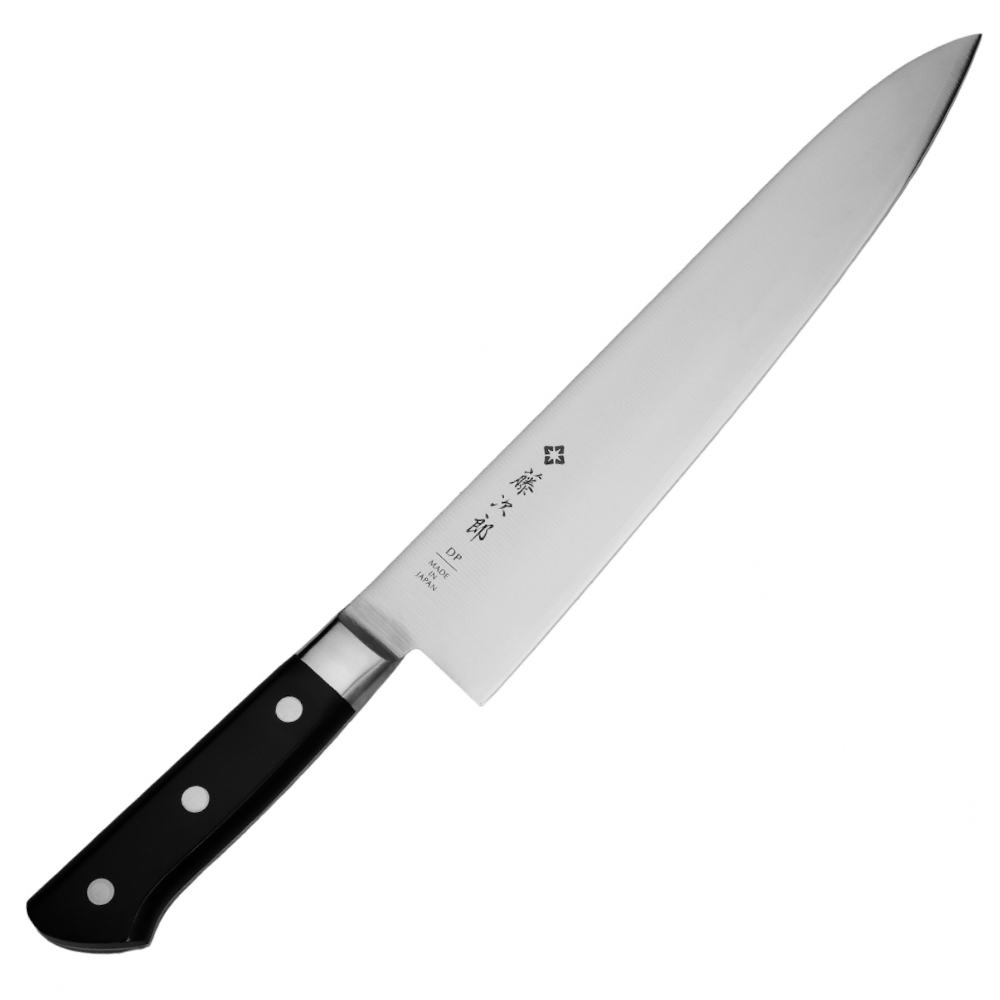
Tojiro DP Gyuto 270 mm (F-810)
ข้อมูลจำเพาะ
| Overall Length | 405 mm |
| Blade Length | 270 mm |
| Weight | 290 g |
| Blade Material | VG10 + 13 Chrome Stainless Steel |
| Handle | Reinforced Laminated Material |
| Edge | Double-edged |
| Brand | Tojiro |
| Country of Origin | Japan |
TOJIRO CLASSIC Gyuto 270 mm — F-810
A long knife you should choose because you truly need it
As a Gyuto grows from 180 to 210 and 240 mm, you gradually gain more cutting space.
But at 270 mm, the story starts to change a little.
Because the F-810 isn’t just a Gyuto with more cutting reach.
It’s a knife that begins to ask that your workspace, your kind of work, and you as the user suit it as well.
The TOJIRO CLASSIC F-810 has a 270 mm blade, an overall length of about 405 mm, and weighs about 295 g. The moment you pick it up, you clearly feel its size and weight.
That isn’t a drawback.
It’s the reason why anyone choosing the F-810 should know what they want from a long knife.
From 240 to 270 mm — only 30 mm more on paper, but the feel changes much more
The 240 mm F-809 weighs about 240 g.
The 270 mm F-810 adds just 30 mm of blade, but its weight rises to about 295 g.
A difference of about 55 g.
So moving from the F-809 to the F-810 isn’t simply extending the blade another 3 cm.
What also changes is the mass of the knife and how it feels as you work.
With large ingredients, this weight works well together with the force of your hand. The knife feels steady, with an edge long enough for continuous cuts in a single stroke.
But for small tasks, frequent turning of the knife, or working on a small board, that same weight and length can become more than you need.
This is where the F-810 clearly begins to set itself apart from the F-808 and F-809.
A knife that loves large ingredients
The advantages of 270 mm become easy to see as ingredients get bigger.
- Large cuts of meat
- Fish
- Cabbage
- Watermelon
- Pumpkin that has already been portioned
- Or prepping ingredients in large quantities
A long blade leaves more edge available as you cut, and lets you draw it through the food in longer strokes.
Instead of cutting halfway and repositioning the knife, you have a better chance of finishing the cut in a single stroke.
When cooking just one or two dishes, this advantage may not matter much.
But in a kitchen that cuts ingredients over and over all day,
the extra edge in every stroke starts to become real working space.
But 270 mm doesn’t mean you need more force
A big knife doesn’t mean you have to grip harder or push harder than before.
On the contrary, used the right way, the length of the blade and the weight of the knife can do part of the work for you,
especially with slicing or push cuts that let you use the full length of the edge.
Instead of trying to force the blade down into the food,
we let sharpness, weight and the movement of the blade work together.
This is one of the reasons a long knife can feel very natural to those who are used to it.
But your cutting board needs to grow with the knife
The F-810 is over 40 cm long overall,
so counter space and cutting board size are no longer small matters.
If your board is so short that the tip often extends beyond the work area, or your prep space is so narrow that you have to keep watching the things around you, you won’t get the full benefit of 270 mm.
In that situation, the F-808 or F-809 may actually work better, even with a shorter blade.
Because a knife never works alone.
The knife, the board, the space and the user are one system.
So if you choose the F-810, choose it because your workspace can accommodate its length too.
What if you want 270 mm just for slicing?
Here’s another interesting question,
because TOJIRO CLASSIC also offers the Sujihiki F-806 at 270 mm.
The F-806 has the same 270 mm blade length but weighs about 240 g, while the Gyuto F-810 weighs about 295 g.
The reason is that the two knives are built for different jobs.
The Sujihiki has a shape focused mainly on slicing, so it’s ideal if your work is slicing meat or cutting ingredients into beautiful portions with long strokes.
But the F-810 is still a Gyuto.
It has to do more than that.
- Go back to cutting vegetables
- Fine slicing
- Push cuts
- Work on the board with the heel of the blade
- Then go back to slicing meat again
So if you want a long knife because you need a slicer, a specialized knife like a Sujihiki may be the more direct answer.
But if you want a 270 mm chef’s knife,
that’s the reason for the F-810.
At 270 mm, it becomes about “how you work” more than “hand size”
When it comes to choosing a knife, we often hear the advice:
small hands, small knife;
big hands, big knife.
But for a Gyuto this size, I think there’s a more important question:
“How do you work?”
If you
- use a large cutting board
- prep ingredients in large quantities
- regularly cut large ingredients
- like using a long stretch of edge
- and are used to a knife with weight in your hand
then 270 mm clearly starts to make sense.
But if most of your work is preparing small dishes on a medium-sized board, then even with big hands, the F-808 or F-809 may be more convenient.
So knife size should be chosen by the work rather than the size of the person.
The F-810 is still part of the CLASSIC philosophy
The F-810 keeps the fundamental design of TOJIRO CLASSIC — a VG10 Clad blade, a Reinforced Laminated Full Tang handle with three rivets, and a Metal Bolster, just like the other members of the series.
TOJIRO states that some CLASSIC shapes received the Good Design Award in 1981, and later, in 1996, received the Good Design Award and the Long-Life Design Award again.
So what’s interesting about the F-810 isn’t necessarily which award marks this particular SKU carries,
but that it still speaks the same design language as the CLASSIC line that has been in use for decades.
A simple form,
no unnecessary decoration,
and everything built around the knife’s function.
Who is the F-810 for?
- If you want agility — F-807 — 180 mm
- If you want a main knife that easily covers everyday work — F-808 — 210 mm
- If you like the advantages of a long blade but still want a manageable size — F-809 — 240 mm
But when you get to F-810 — 270 mm,
the question shouldn’t be
“Is a bigger knife better?”
but rather
“Does my work need a knife this size?”
If the answer is yes, 270 mm gives you a cutting reach, weight and steadiness that shorter knives can’t quite match.
But if the answer is no,
there’s no reason the F-810 has to be a better choice than the F-808 or F-809.
And that may be the greatest charm of a knife this size.
The F-810 doesn’t try to be a Gyuto for everyone.
It’s a Gyuto for those who already know what they’ll do with those extra 30 mm.