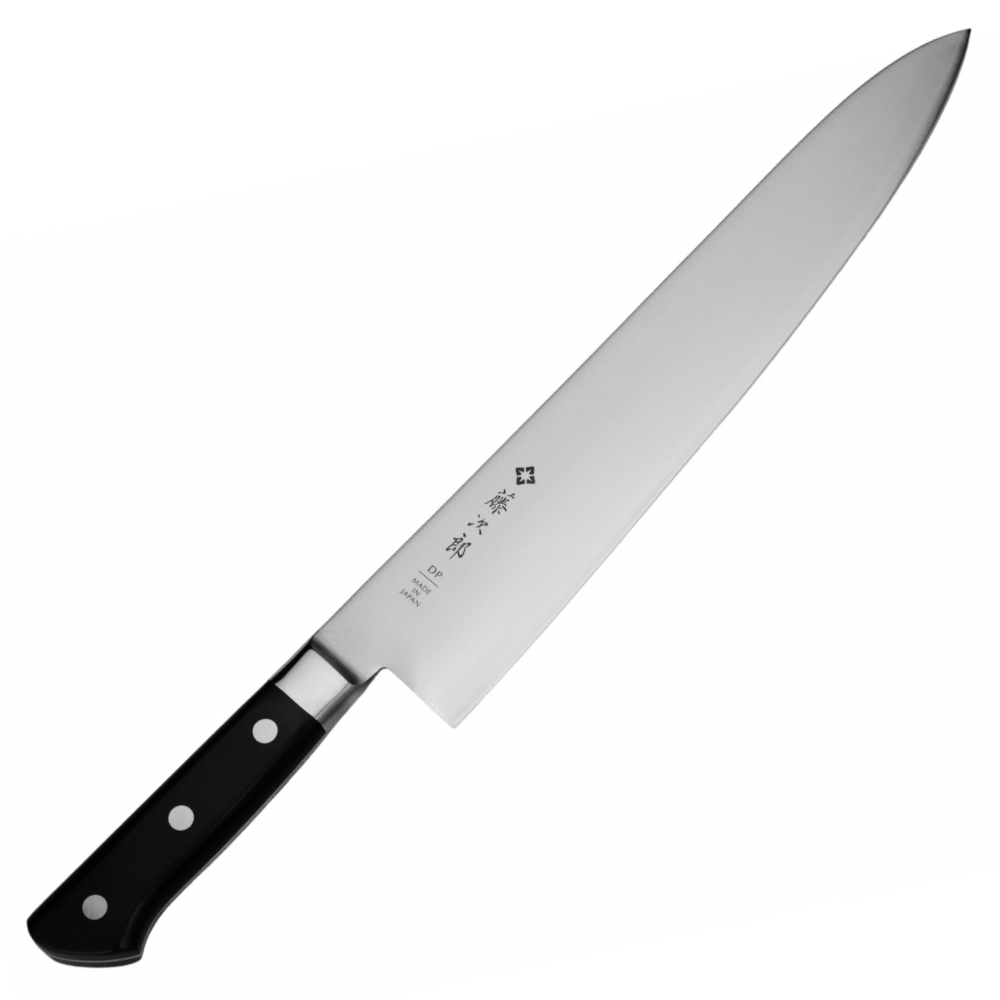
Tojiro DP Gyuto 300 mm (F-811)
ข้อมูลจำเพาะ
| Overall Length | 435 mm |
| Blade Length | 300 mm |
| Weight | 330 g |
| Blade Material | VG10 + 13 Chrome Stainless Steel |
| Handle | Reinforced Laminated Material |
| Edge | Double-edged |
| Brand | Tojiro |
| Country of Origin | Japan |
TOJIRO CLASSIC Gyuto 300 mm — F-811
When the knife has to keep up with the size of the job
A 300 mm Gyuto may look bigger than many people need.
And the truth is — it may well be.
The TOJIRO CLASSIC F-811 wasn't made to chop a single onion or prep a small meal more easily than a 210 mm Gyuto.
The reason for a knife this size only appears when the scale of the work grows to match it
- Large ingredients
- A large cutting board
- A wide prep area
- And work that has to be repeated in large volumes
When all of these come together, a 300 mm blade no longer looks big for no reason.
ใบมีด 300 mm ให้ “ระยะในการทำงาน” มากขึ้น
The F-811 has a 300 mm blade, an overall length of about 435 mm and weighs about 325 g
สิ่งที่เราได้จากความยาวใบมีดที่มากขึ้นคือ คมมีดที่มีระยะให้ใช้งานมากขึ้น
When cutting large ingredients, you can start the stroke from one part of the blade and let the edge travel a long way through the food before you run out of blade.
Especially when slicing, this length lets the cut happen in a more continuous stroke instead of many short back-and-forth sawing motions.
In this kind of work,
the length of the knife isn't a burden —
it becomes working space
From 270 to 300 mm — the difference lies more in the ingredients than in the knife
The 270 mm F-810 is about 405 mm overall and weighs about 295 g.
The F-811 adds another 30 mm of blade, bringing the overall length to about 435 mm and the weight to about 325 g.
A difference of only about 30 g
So moving from 270 to 300 mm doesn't change the knife's character as dramatically as the first jump from a mid-size knife to a long one.
The key question starts to change from
“Can I handle a knife this size?”
to
“Can my work make use of these extra 30 mm?”
If you mostly cut medium-sized ingredients on a regular board, the extra 30 mm may not make enough difference.
But if you regularly work with large ingredients, the added edge length can really matter.
The F-811 needs a board that lets it truly be a 300 mm knife
This may matter even more than the steel specs.
A 300 mm blade can't be used to the full if you put it on a board too small to move the blade.
The F-811 is more than 43 cm long overall.
Add space for the ingredients and for moving your hands, and you need a fairly wide work area.
If the board supports only part of the blade, or the area around it is crowded with containers and other tools, you'll constantly be lifting the knife and working around things.
In the end, the length that should be an advantage can become a burden.
That's why, as knives get bigger,
board size and work space become part of choosing the knife
เหตุผลของ F-811 จะเห็นชัดในงานที่มี “จำนวนมาก”
ลองเปรียบเทียบการเตรียมต้นหอมกำโตกับต้นหอมกำเล็กๆ ระยะใบมีดที่ใช้งานจะแตกต่างอย่างชัดเจน
หรือการหั่นเนื้อชิ้นเล็กสำหรับอาหารหนึ่งมื้อ กับการ portion เนื้อก้อนใหญ่ต่อเนื่องหลายชิ้น
ขนาดใบมีดที่เหมาะสมกับงานย่อมจะต่างกันอย่างชัดเจน
As the volume of work grows, we don't just ask “Can this knife cut it?”
After all, a 180 mm Gyuto can cut almost anything too.
The question becomes
“How efficiently can we do that work over and over?”
This is where a long blade starts to show its value.
The F-811 gives enough edge for large ingredients and a long range of motion for continuous cutting.
It becomes a knife tied to the scale of the work rather than the size of a single dish.
So why a 300 mm Gyuto?
After all, dedicated slicing knives exist.
If all your work is slicing meat, a Sujihiki may be the better fit, with its narrower blade designed specifically for pull cuts.
But the F-811 is still a Gyuto.
Its blade width lets it work on the board: the heel for chopping, the middle for push cuts and the tip for detailed work.
So the reason for a 300 mm Gyuto isn't just
“I want a long slicing knife”
but
“I want a full chef's knife — just with a working length of 300 mm”
Those are not the same thing.
Bigger doesn't mean more force
Seeing the F-811, many people may think a heavier knife needs more force.
But using a long knife well is more about the movement of the blade than pressing straight down hard.
The roughly 325 g weight and the blade length help build momentum as you cut.
With the right rhythm, you can let sharpness + weight + blade travel work together
instead of relying on wrist strength alone.
That's why a very long knife can feel clumsy to someone unfamiliar with it,
yet surprisingly natural to someone who has learned to work with it.
What the F-811 trades for its length
Of course, no advantage comes for free.
- 300 mm means turning and changing direction takes more space
- Small tasks that need frequent knife movement may feel less nimble than with 180 or 210 mm
- Storage has to accommodate a 300 mm blade
- The cutting board has to be bigger
- You need more space around you
- And you have to get used to always knowing where the tip is
This isn't a flaw in the F-811.
It's the natural result of choosing a large tool,
and the reason why people who won't use the 300 mm length don't need to choose it.
The F-811 is still built on TOJIRO CLASSIC foundations
Although the size has changed, the F-811 keeps the same concept as the other CLASSIC models:
- VG10 core clad in 13-chrome stainless steel
- Reinforced Laminated Material handle
- Full Tang construction
- Three rivets
- Metal bolster
- Double Bevel edge
None of this makes the F-811 a flashy knife.
On the contrary, it still looks very simple.
But at 300 mm, that simplicity makes it even clearer that this knife wasn't made for show.
Every bit of it is there for work
So, 270 or 300 mm?
If you already know you like long Gyuto and want a knife that's still fairly easy to manage in a typical professional kitchen,
the 270 mm F-810 makes a lot of sense.
But if you often find that a 270 mm blade runs out before you want it to when cutting large ingredients,
or your workload and board size let you use a 300 mm blade to the full,
that's when the F-811 starts to make sense.
Not because 300 mm is “better” than 270 mm,
but because your work can really use those extra 30 mm of edge.
So the F-811 isn't a Gyuto we need to sell to everyone
Most people don't need a 300 mm Gyuto,
and that's fine.
Because a good tool doesn't have to suit the largest number of people —
it should suit the work it was made for
- With the F-807, we choose for agility
- The F-808, we choose for balance
- The F-809, we start choosing for cutting range
- The F-810, we choose for the way we work
But with the F-811,
we are choosing by the scale of the work
And if your work is big enough to really use a 300 mm blade,
the F-811 no longer looks like a knife that's too big —
it's simply the right size for what you're doing.