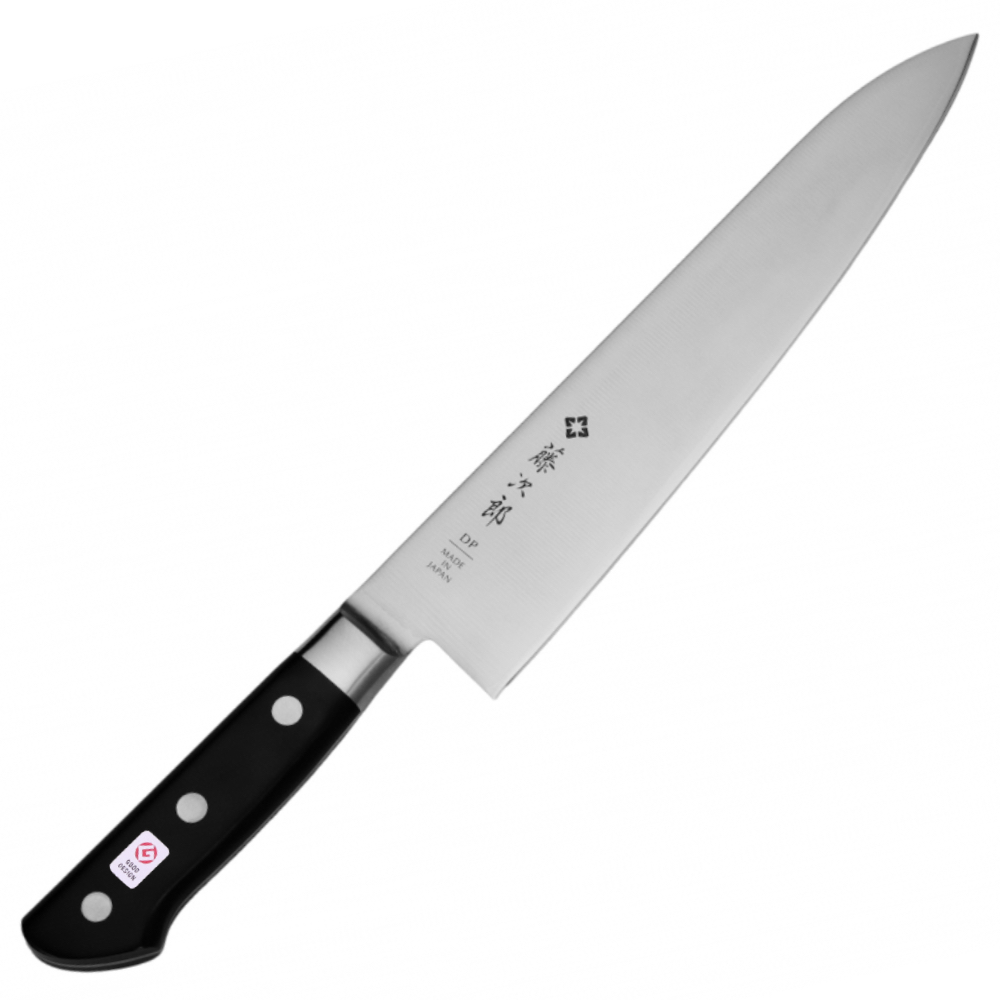
Tojiro DP Gyuto 240 mm (F-809)
ข้อมูลจำเพาะ
| Total Length | 365 mm |
| Blade Length | 240 mm |
| Weight | 240 g |
| Blade | VG10 + 13 Chrome Stainless Steel |
| Handle | Reinforced Laminated Material |
| Edging | Double Bevel |
| Brand | Tojiro |
| Country of Origin | Japan |
TOJIRO CLASSIC Gyuto 240 mm — F-809
When blade length becomes part of how you work
If the 180 mm F-807 stands out for agility,
and the 210 mm F-808 sits at the balanced middle point that makes it an ideal main kitchen knife,
the 240 mm F-809 is where you begin to clearly feel the advantages of a “long blade.”
The extra length isn’t only there for handling large ingredients.
It changes the rhythm of how you use the knife.
A longer cut in a single stroke
Think about slicing a large piece of meat, portioning a cut, shredding cabbage, or working with wide vegetables.
With a longer blade, you can draw the edge through the food over a greater distance in each stroke, reducing the need to stop and start a new cut again and again.
This is an advantage you often can’t see in the numbers on a spec sheet,
but you feel it immediately once you start using a long knife on large ingredients.
So the F-809 doesn’t just “reach further” — it gives you more working edge in every stroke.
240 mm — entering the territory of serious work knives
The F-809 has a 240 mm blade, an overall length of about 365 mm, and weighs about 240 g.
Compared with the 210 mm F-808 at about 200 g, the F-809 isn’t just 30 mm longer — it’s also noticeably heavier.
That difference changes the knife’s character.
Place the F-809 on the cutting board and you feel more “knife” than with the F-807 or F-808.
For those who like a light knife that changes direction quickly, this feeling may be more than they need.
But for those who like a knife with some weight in the hand, and who handle large quantities or large ingredients, this weight and length actually become part of what helps the work along.
But the F-809 is still a Gyuto — not just a slicer
Although its 240 mm length gives the F-809 an advantage in slicing, the important thing is that it remains a Gyuto.
It wasn’t designed to work only on meat.
You can still use the heel for everyday chopping, the middle for push cuts and slicing, and the tip for detailed work.
That’s what makes the F-809 interesting: it combines two advantages in one knife.
- The cutting reach of a long knife
- With the versatility of a Gyuto
If your main task is slicing meat specifically, a Sujihiki has a more specialized shape.
But if you want a long-bladed knife that still works as a full chef’s knife, the F-809 offers more flexibility.
A longer knife needs more space, too
The advantages of 240 mm come through fully when your workspace supports them.
A larger cutting board lets you actually use the whole length of the edge, with room to move the blade without feeling cramped.
On the other hand, if you use a small board, cook in a tight space, or mostly prep small quantities, the advantages of 240 mm may simply go unused.
That’s why choosing a Gyuto length shouldn’t be about
“longer is better”
but rather
“Can my space and the way I work make use of that length?”
So how different is 240 mm from 210 mm?
On paper, the difference is only 30 mm.
But those 30 mm sit in the most important part of the knife — the edge you cut with.
The 210 mm F-808 has an overall length of about 335 mm and weighs about 200 g, while the F-809 is about 365 mm long overall and weighs about 240 g.
So when you actually hold it, the difference isn’t just “the tip sticks out another 3 cm.”
The F-809 gives you both a longer cutting reach and more knife in your hand.
For small tasks, that difference may not be very useful.
But as ingredients get bigger, or the work goes on longer, the extra length starts to make sense.
A design that has proven itself over time
The F-809 belongs to the line descended from TOJIRO DP with Bolster, the origin of today’s TOJIRO CLASSIC.
The design of this series received the Good Design Award and the Long-Life Design Award in 1996.
So what’s interesting isn’t just having an award mark attached to the product,
but that the thinking behind this knife — a practical blade, a Full Tang handle, three rivets and a Metal Bolster — still meets real-world needs even after several decades.
For a tool like a knife, this may mean more than a flashy design on launch day. A good form doesn’t always need to change with the times. Sometimes it simply needs to do its job well enough that there’s no reason to change.
Who is the F-809 for?
If agility is your top priority,
the 180 mm F-807 is the more appealing choice.
If you want a single main knife and aren’t yet sure whether you like long knives,
the 210 mm F-808 is an easier, more balanced starting point.
But if you
- have enough cutting board space
- like a knife with some weight in your hand
- handle large ingredients
- enjoy cuts that make full use of a long edge
the 240 mm F-809 begins to show advantages that shorter knives can’t offer.
It isn’t a Gyuto for everyone.
But for those who have discovered they love long knives,
the extra 30 mm over the F-808 may not be excess at all — it’s working space you’ll soon never want to give up.