Japanese knives— can you use an ordinary whetstone on them?
Is there one stone that will sharpen every kind of knife?
These are questions we get very often. Easy to ask, long to answer. Let's begin.
First, a rough outline for anyone who has not dealt with whetstones before.
Grit is the fineness of the stone. The higher the number, the less metal the stone removes at a time; the lower the number, the more metal it takes off the blade at a time. To make this easier to picture,
here is roughly how we would group them
- Coarse (0-599 grit)
2. Medium (600-1999 grit)
3. Fine (2000-5000 grit)
4. Very fine (5001-12000 grit and above)
Here is the thing: most Japanese knives take a good edge, with a hardness of around 56 HRC (the hardness of the blade) or above. So the stone most often used on these Japanese knives is around 1000 grit (the medium range), which gives a good, workable edge.
But that is not the whole story — there is also the hardness or toughness of the steel to consider. For most Japanese knives, the Naniwa Medium Stone at 1000 grit gives quite satisfying results.
And what about knives from other countries?
Let us turn to European knives, which inevitably means the knives from the beer country, the most widespread here: brand W and brand Z. In our experience, brand W is clearly easier to sharpen than Z. Either way, with both brands, if you are not a skilled sharpener the Naniwa Medium Stone 1000 grit will wear you out and get you almost nowhere, because the hallmark of German knives is how tough they are. We would recommend the Naniwa Traditional Stone 1000 grit (a line Naniwa designed specifically for European knives), because it cuts metal very quickly and makes life much easier.
The question then is what happens if you use this stone on a Japanese knife. The answer depends on the case. With a stainless Japanese knife there is no problem at all — it only goes faster. But with carbon-steel knives (the kind that can rust), Naniwa does not really recommend it, because the stone removes metal too quickly. Carbon steel is already fairly easy to sharpen, so it is unnecessary.
And Thai knives?
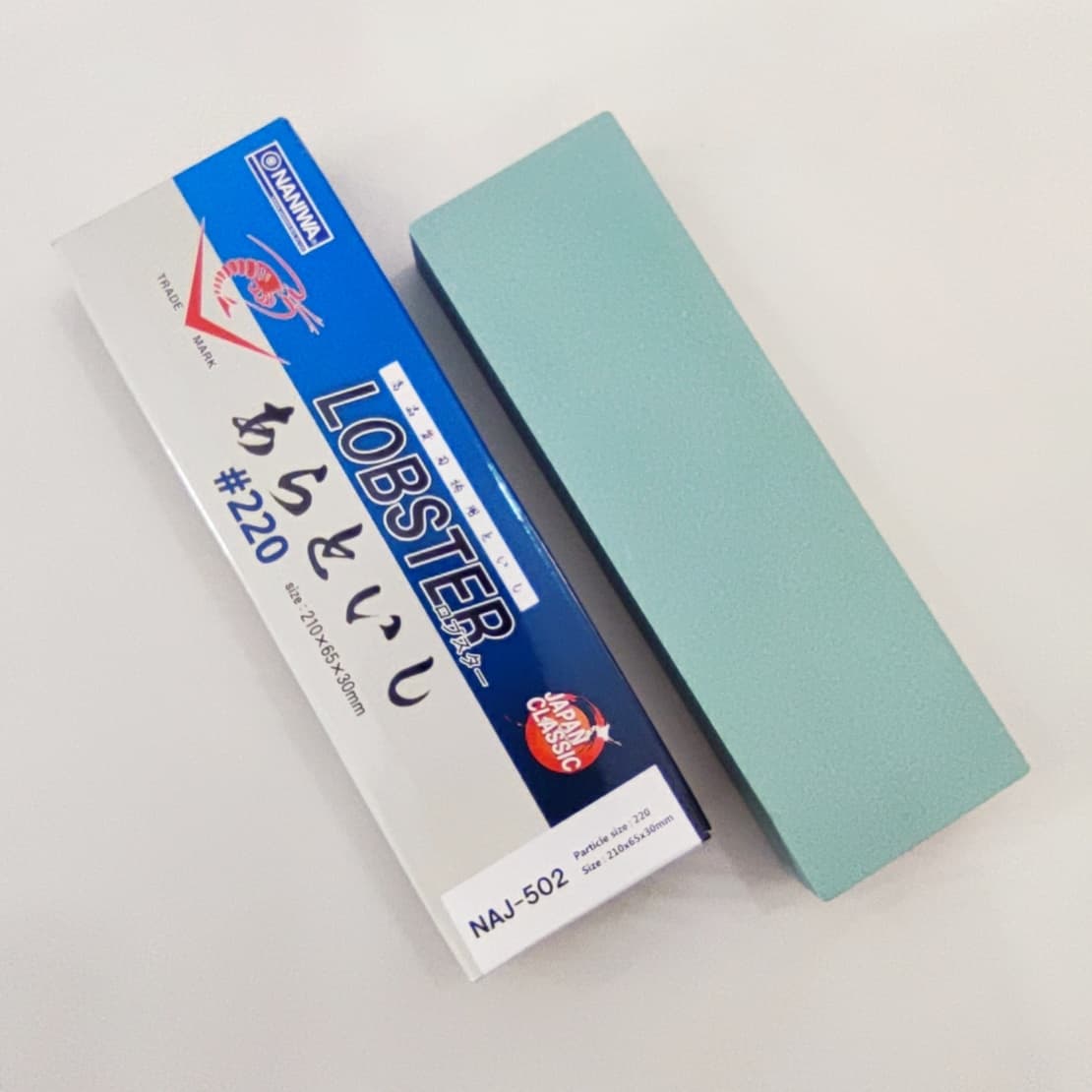
Most Thai-brand knives under 100 baht have a fairly coarse steel structure, and the steel is also quite soft. So if you use a 1000-grit stone it will take off very little metal and the knife will never come sharp. The recommendation is that around 220 grit is enough. Does Naniwa make a stone that coarse? Yes — the Naniwa Aoebi 220, Made in Japan. But it costs a little over two thousand baht, some twenty times the price of a knife under a hundred; that is rather like riding an elephant to catch a grasshopper. So the recommendation is the Naniwa Lobster 220 grit, Made in Vietnam, which comes at a much friendlier price. Naturally a stone made in Vietnam does not cut metal as fast as one made in Japan — but does it matter, when the steel we are sharpening is soft anyway? In our experience it works very well. We should say up front that we have not tried every brand in this price range, though we have tried a fair number.
What about Chinese knives?
The Chinese knives we have come across are of noticeably better quality than Thai ones — still a long way from Japanese knives, of course. In this case we would recommend the Naniwa Lobster 1000 grit, Made in Vietnam, for anyone wanting to economise, because the steel structure is acceptable while the hardness is still well below Japanese knives, so the Naniwa Lobster 1000 grit, Made in Vietnam can still cope. If you prefer easy, fast sharpening, the Naniwa Medium Stone 1000 grit, Made in Japan is better still. Conversely, can the Naniwa Lobster 1000 grit, Made in Vietnam be used on a Japanese knife? You will be sweating over it — wearing out the knife, the stone and your time. It really is not worth it.
Everything written here comes from both knowledge and experience. On the experience side, others may well have had different results with these stones than we have. We also admit that not everything can be put into writing. If anything here is unclear, or you would like to ask us in person, or you want to know which stone suits your knife, call to arrange a time and come to the shop. We are there almost every day.